

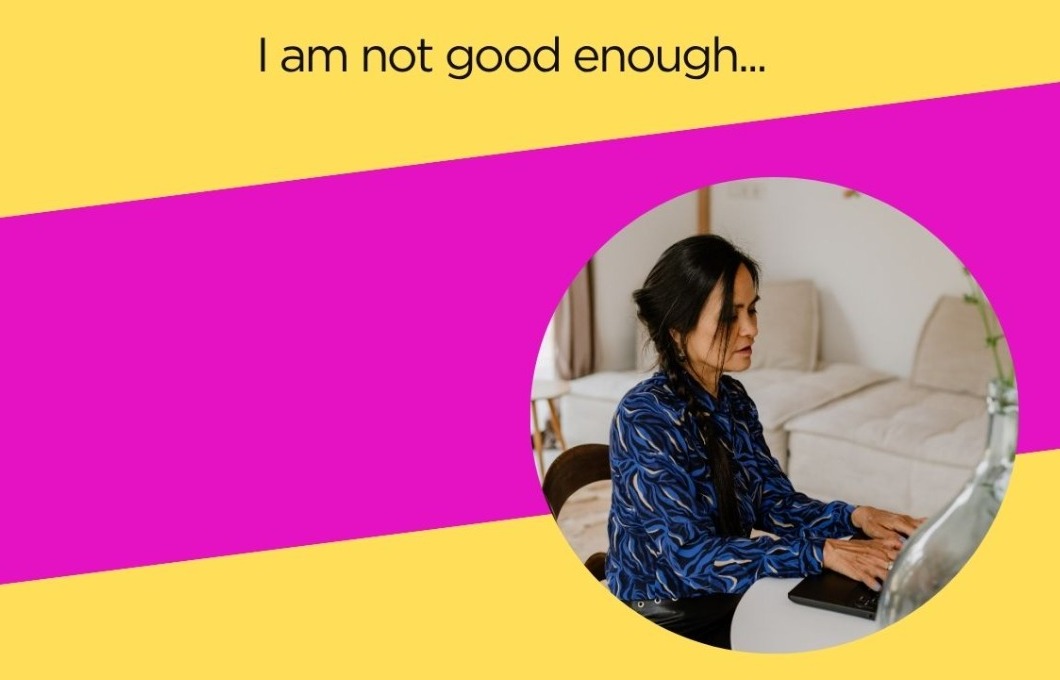
Wrecked. Absolutely wrecked.
One day after a three-day spiritual voice workshop, and I can barely lift a coffee cup. And all I did was sing. In a group. For fun, I thought. A nice little outing with Jan Geurtz, whose trainings and retreats I've followed with real interest for years, and who I once had the pleasure of interviewing.
Turns out singing can flatten you harder than a week of back-to-back client sessions. Who knew.
What surfaced
Apparently I've gotten very good, lately, at papering over my own deepest negative beliefs. Papering over. Not resolving them. Not processing them. Not giving them a seat at the table. Just papering over them, beautifully, like a very well-decorated crack in the wall.
Because confidence built on your identity, on your self-image, can be deeply misleading. It doesn't bring you closer to yourself. It takes you further away.
Dzogchen, an old Tibetan Buddhist teaching, says the same thing. Put simply: who you really are doesn't live in your thoughts, your personality, or your self-image. Those things are more like the clothes you put on. Who you are underneath stays the same. Quiet. Still. Pure. Without judgement.
My work as a psychologist speaks to that first layer. The self-image. The clothes. That's the level I wrote my book, Happy from the Inside Out, for, and for good reason: it's the level most people live on, and there's still an enormous amount to gain there. I've known for years there's more beneath it. But knowing something and feeling it are two very different animals. Yesterday, I met the animal.
A self-image is still a shell
Living from that surface version of yourself can feel wonderful. A disturbed or negative self-image hurts. A positive one feels a lot better. But the moment it takes a knock, one wrong look from someone, one careless remark from a colleague, your deepest negative belief about yourself is back on the surface within seconds.
I'm not good enough.
I don't matter.
I'm weak.
I'm ugly.
I'm worthless.
Or whichever negative belief you happen to carry.
That belief didn't come from nowhere. It came from your childhood. Were you slow to be toilet trained? Were you "too much" or "too loud" for your parents? Did you get pulled up for not speaking clearly enough?
And there it is. Free of charge, no invoice attached, you're handed the belief that you, as you are, aren't good enough.
Not because the adults around you meant it that way. Usually the opposite. But a child draws conclusions fast, and cheaply. And that conclusion settles in. For years. Until a voice workshop drags it back into daylight.
Your voice doesn't leave much to guess
Using your voice, in front of a group no less, turns out to be a shortcut straight to old self-rejection. A shortcut nobody warned me about.
Do you dare sing loudly, or do you shrink the second you feel like "too much"? Do you secretly think you sing badly? Do you quietly judge how someone else sounds? Does your stomach drop at the thought of being next to make a noise? Would you rather stay as small and quiet as humanly possible? Can you step forward, properly, in front of twenty-five people?
I'd bet good money you felt something at one of those questions. Using your voice, putting it out there for other people to hear, exposes far more of a person than I'd bargained for.
Other trainings this year had already grown my self-image and self-confidence enormously. I felt strong. Steady. More at home in myself than ever.
Then came the singing, and suddenly I was back to being the nervous new kid.
Looking without bolting
Did that bother me? At first, yes. My inner monologue went something like: for heaven's sake, I do this work for a living, and here I am, straight back in self-rejection. But now I see it as an opening. A chance to look at my own self-rejection with kindness. Without judgement. Without trying to fix it, edit it, or hurry it along. Not bolting for my phone. Not bolting into busyness. Not bolting into a tub of comfort food. Just looking. A few minutes at a time. And writing about it here, which, quietly, I'm rather enjoying.
Seeing reality as it actually is, without the running commentary in my head, is not easy. I'd lost touch with that deeper layer for a while, simply because I've been living in a fairly comfortable self-image lately. And when things are going well, there's not much incentive to dig further. You can manage the negative thoughts just fine on autopilot, so why would you bother.
On a purely psychological level, working with your voice is enormously valuable. It was the combination with the spiritual side that made this training so worthwhile for me. So yes, I'd genuinely recommend it to anyone who wants to live more consciously, and who's willing to let their own self-image, especially the unflattering parts, get a bit of a shake.
You'll find more information about the Spiritual Voice Liberation workshop on Jan Geurtz's (Dutch) website.